|
View News Release Online
Vancouver, Canada – April 21, 2022 –
Canagold Resources Ltd. (TSX: CCM, OTC-QB: CRCUF,
Frankfurt: CANA)
announces high-grade gold assays for six more drill
holes from the expanded drill program at its 100% owned
New Polaris Gold project located in northwestern British
Columbia, 100 kilometers (km) south of Atlin and 60 km
northeast of Juneau, Alaska.
The assay results include samples from
drill holes that have returned significant intercepts of
gold mineralization in the C-West Main (“CWM”).
Highlights:
-
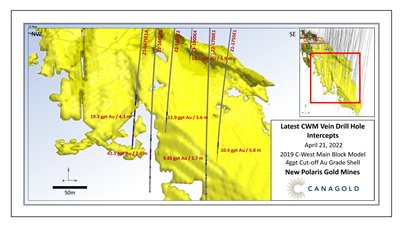
42.5 grams per tonne (“gpt”) gold
(“Au”) over 2.0 metres (“m”) from 466.1 m in Hole
22-1665E1
o Including 69.7 gpt Au over 0.8 m from 466.6 m
-
19.3 gpt Au over 4.3 m from 410.5 m
down the hole, in Hole 21-1675E1A
o Including 33.2 gpt Au over 1.0 m from 411.0 m
-
10.4 gpt Au over 5.8 m from 460.5 m
in Hole 21-1755E1
-
10.5 gpt Au over 4.9 m from 268.8 m
in Hole 21-1800E4
-
12.9 gpt Au over 3.6 m from 408.5 m
in Hole 22-1692E1
-
9.43 gpt Au over 1.7 m from
469.9 m in Hole 22-1700E1
Scott Eldridge, Canagold CEO, said,
““In
addition to significant infill results, this most recent
batch of assays has intercepted robust mineralization
within known gaps in the resource model. We see multiple
opportunities for resource expansion in parallel veins
as well as expanding the C West Main Vein where a known
gap area has now intercepted 42.5 grams over 2 metres.
We are seeing excellent continuity in our infill efforts
as we move towards upgrading inferred resources to
measured and indicated. The tighter drill spacings are
delivering significant grade over widths that support
the PEA mine plan. We anticipate additional results in
the coming weeks.”
Click to enlarge image
Click to enlarge image
Detailed information for the six drill holes and the
sample assay results and mineralized intercepts are
provided in
Table 1
and
Table 2
below.
All of the planned 47-holes of the
originally proposed 24,000 m infill drill program were
completed by the end of 2021 and assay results have now
been received for 43 holes. An additional 6,000 meters
of drilling in 7 holes were completed in January and
February 2022. The samples collected from the
mineralized zone in all of those holes have been
submitted to the ALS Geochemistry lab in Whitehorse, YT
for gold analysis. Results from the remaining holes will
be released as they are received in the coming weeks.
Drilling has now been completed for the
season prior to the spring thaw. Drilling equipment is
being stored on site ready for the start of the next
drilling campaign in the summer of 2022.
Infill Holes to Upgrade Inferred
Resources to Indicated Resources
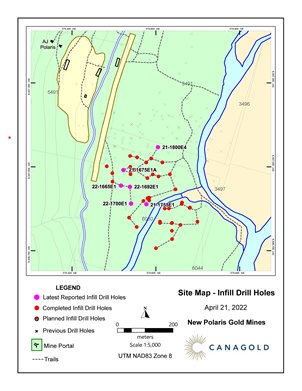
The current drill program is designed primarily to
in-fill drill the Inferred Resources of the CWM vein
system within the currently defined resources in the
PEA*.
The infill
drill holes range in depth from 300 to 650 m and are
designed to provide greater density of drill intercepts
(20 – 25 m spacing) in areas of Inferred Resources
between 150 and 600 m below surface. The improved drill
density will be used to
upgrade parts of the Inferred Resources
to Indicated Resources for inclusion in a future
feasibility study.
*The New Polaris resource is contained
within a preliminary economic assessment (“PEA”) report
which was prepared by Moose Mountain Technical Services
in the format prescribed by NI43-101 Standards of
Disclosure for Mineral Projects, and filed on Sedar
April 18, 2019.
New Polaris Overview
Canagold’s flagship asset is the 100%
owned New Polaris Gold Mine project located in
northwestern British Columbia about 100 kilometers south
of Atlin, BC and 60 kilometers northeast of Juneau,
Alaska. The property consists of 61 contiguous
Crown-granted mineral claims and one modified grid claim
covering 850 hectares.
New Polaris lies within the Taku River
Tlingit First Nations traditional territory. Canagold is
committed to providing employment and business
opportunities that help support the local economies in
the vicinity of its exploration projects.
The New Polaris gold deposit is an early
Tertiary, mesothermal gold-bearing vein system occupying
shear zones cross-cutting late Paleozoic andesitic
volcanic rocks. It was mined by underground methods from
1938 to 1942, and again from 1946 to early 1951,
producing approximately 245,000 oz gold from 740,000
tonnes of ore at an average grade of 10.3 gpt gold.
Three main veins (“AB, C and Y”) were mined to a maximum
depth of 150 m and have been traced by drilling for up
to 1,000 m along strike and up to 800 m down dip, still
open for expansion. The gold occurs dominantly in finely
disseminated arsenopyrite within quartz-carbonate
stock-work veins and altered wall-rocks. Individual
mineralized zones extend up to 250 meters in length and
14 meters in width. Average widths more commonly range
from 2 to 5 meters.
Qualified Person
Garry Biles, P.Eng, President & COO for Canagold
Resources Ltd, is the Qualified Person who reviewed and
approved the contents of this news release.
Drill Core Sampling and Quality Assurance
– Quality Control Program
Drill core is geologically logged to identify the gold
mineralized zones that are allocated unique sample
number tickets and marked for cutting using a
purpose-built diamond blade rock saw. Half core samples
are collected in labelled bags and the other half
remains in the original core box stored on site. Quality
control (QC) samples including certified reference
material standards, blanks and duplicates are inserted
into the sample sequence at intervals of one in ten on a
rotating basis to monitor laboratory performance and
provide quality assurance (QA) of the assay results.
Several sample bags are transported together in rice
bags with unique numbered security tags attached and
labelled with Company and lab contact information to
ensure sample security and chain of custody during
shipment to the lab.
The samples are submitted to the ALS
Geochemistry lab in Whitehorse, YT for preparation and
assaying. The entire sample is crushed to 70% passing -2
millimeters and a 250 gram aliquot is split and
pulverized to 85% passing -75 microns. Analysis for gold
is by 30 gram fire assay and gravimetric finish. A suite
of 30 other elements including arsenic, antimony, sulfur
and iron are analyzed by aqua-regia digestion
Inductively Coupled Plasma Atomic Emission Spectroscopy
(ICP-AES). ALS Canada Ltd. is accredited by the
Standards Council of Canada and is an ISO/IEC 9001:2015
and 17025:2017 certified analytical laboratory in North
America.
"Scott Eldridge”
____________________
Scott Eldridge,
Chief Executive Officer
CANAGOLD RESOURCES LTD.
About Canagold
-
Canagold Resources Ltd. is a
growth-oriented gold exploration company focused on
generating superior shareholder returns by discovering,
exploring and developing strategic gold deposits in
North America. Canagold shares trade on the TSX: CCM and
the OTCQB: CRCUF.
For More Information -
Please contact: Knox Henderson, VP
Corporate Development
Toll Free: 1-877-684-9700 Tel: (604)
604-416-0337 Cell: (604) 551-2360
Email:
knox@canagoldresources.com
Website:
www.canagoldresources.com
Cautionary Note Regarding Forward-Looking
Statements
This news release contains
“forward-looking statements” within the meaning of the
United States private securities litigation reform act
of 1995 and “forward-looking information” within the
meaning of applicable Canadian securities legislation.
Statements contained in this news release that are not
historical facts are forward-looking information that
involves known and unknown risks and uncertainties.
Forward-looking statements in this news release include,
but are not limited to, statements with respect to the
future performance of Canagold, and the Company's plans
and exploration programs for its mineral properties,
including the timing of such plans and programs. In
certain cases, forward-looking statements can be
identified by the use of words such as "plans", "has
proven", "expects" or "does not expect", "is expected",
"potential", "appears", "budget", "scheduled",
"estimates", "forecasts", "at least", "intends",
"anticipates" or "does not anticipate", or "believes",
or variations of such words and phrases or state that
certain actions, events or results "may", "could",
"would", "should", "might" or "will be taken", "occur"
or "be achieved".
Forward-looking statements involve known
and unknown risks, uncertainties and other factors which
may cause the actual results, performance or
achievements of the Company to be materially different
from any future results, performance or achievements
expressed or implied by the forward-looking statements.
Such risks and other factors include, among others risks
related to the uncertainties inherent in the estimation
of mineral resources; commodity prices; changes in
general economic conditions; market sentiment; currency
exchange rates; the Company's ability to continue as a
going concern; the Company's ability to raise funds
through equity financings; risks inherent in mineral
exploration; risks related to operations in foreign
countries; future prices of metals; failure of equipment
or processes to operate as anticipated; accidents, labor
disputes and other risks of the mining industry; delays
in obtaining governmental approvals; government
regulation of mining operations; environmental risks;
title disputes or claims; limitations on insurance
coverage and the timing and possible outcome of
litigation. Although the Company has attempted to
identify important factors that could affect the Company
and may cause actual actions, events or results to
differ materially from those described in
forward-looking statements, there may be other factors
that cause actions, events or results not to be as
anticipated, estimated or intended. There can be no
assurance that forward-looking statements will prove to
be accurate, as actual results and future events could
differ materially from those anticipated in such
statements. Accordingly, do not place undue relianc
|