|
This story has been a long time coming and yes I still
own the stock. TMR Members are well aware of the whole
story as it was outlined in one of the latest issues of
The Morgan Report.
New Look At An Old
Silver Mine Yields Potentially Massive Discovery
Resource is Already Approaching 100 million oz Ag with
Barely 30% of the Structure Drilled. Deposit is Open at
Strike and at Depth
Financed by Eric Sprott, Drills are Turning at this
Bonanza Silver Discovery with Results that have Caught
Investors Completely Off Guard
Prophecy's (PCY.TO; PRPCF.OTCQX) Pulacayo Discovery
Could Soon Produce the Biggest Winner in this Silver
Bull Market
Dear Morgan Report Subscribers,
I just got off the phone with Prophecy management (after
first sitting through the
latest Prophecy presentation on its Pulacayo silver
project) and am immediately at my desk to provide this
update.
Pulacayo is an old story: a high grade historic silver
underground mine in Bolivia at which Apogee Silver Ltd
spent over $28 million drilling from 2005 to 2012 before
Pulacayo was sold to Prophecy in 2015 when silver hit
the bottom. Apogee has since changed its name to focus
on Cannabis business.
An Open-pit Angle at an Underground Story
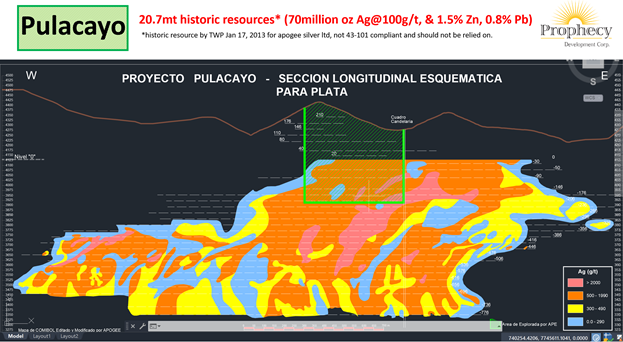
Apogee had taken on the Pulacayo legacy with a plan to
resume underground mining. They drilled in a small area
(30% of the known strike) near the San Leon tunnel and
developed an underground reserve. Unfortunately, they
completely missed the big picture: mineralization starts
from surface and is continuous to a depth of 1,000
meters. Pulacayo is ripe for bulk tonnage open pit
mining, which is an ideal call option on rising silver
prices.
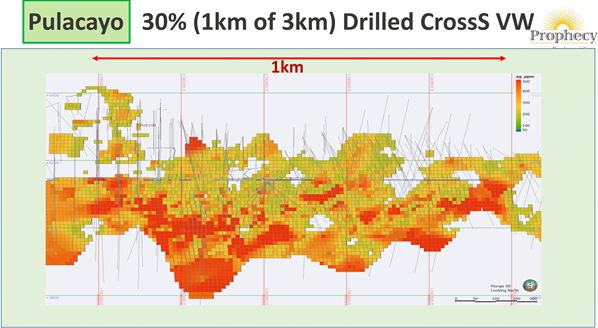
Pulacayo mineralization
starts from surface (100g/t)
with increasing grades (500g/t) at depth.
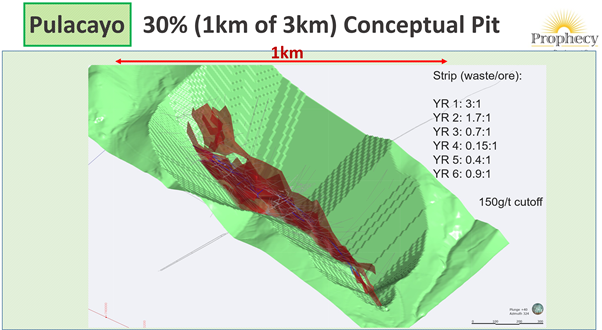

An Example of Re-Disocvery that Reaped Giant Rewards
If you are searching for an example of a profitable new
spin on an old project, look no further than Pulacayo's
neighbor San Cristobal, which is currently the world's
third largest active silver mine.
San Cristobal is 100 km to the southwest of Pulacayo by
highway.
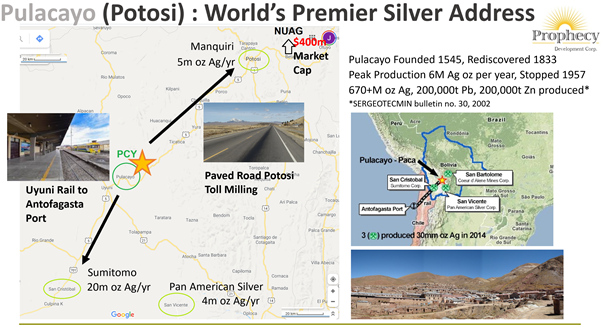
The San Cristobal silver-lead-zinc mine contains 533.38M
oz of silver reserves (Dec. 2011 est.), making it the
third biggest silver mine in the world. It is owned and
operated by Minera San Cristobal (MSC), a wholly owned
subsidiary of the Sumitomo Corporation of Japan.
San Cristobal is an open-pit mining operation with a
40,000 tpd concentration plant. The mine's annual output
is up to 600,000 t of lead, silver, and zinc
concentrates (over 20 million oz silver, 550 million lb
zinc, and 180 million lb zinc).
https://www.mining-technology.com/features/feature-the-10-biggest-silver-mines-in-the-world/
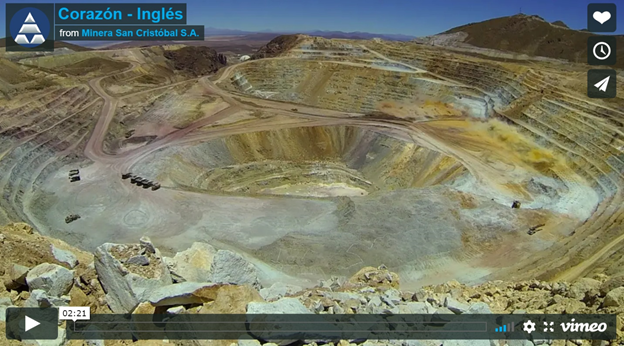
Click to play San Cristobal Clip
San Cristobal was an artisanal high-grade underground
mine in the early 1900s. In 1993 NY financing
billionaire baron Tom Kaplan acquired it, and conceived
and marketed San Cristobal as an open pit operation. It
became a giant success story for Kaplan, who reaped
hundreds of millions of dollars before San Cristobal was
eventually sold to Sumitomo, which commissioned San
Cristobal as an open pit mine in 2010.
With shrewd management by Prophecy, which sees the big
picture and has an execution track record of M&A and
mine development, Pulacayo may just become the next San
Cristobal.
Pulcayo: Successor to San Cristobal?
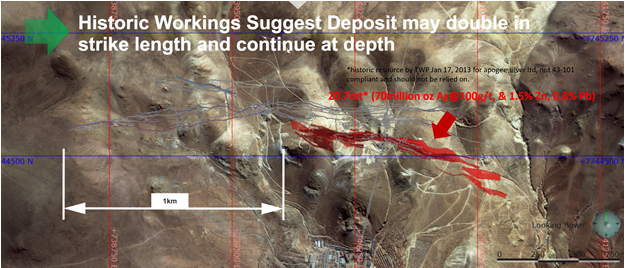
Drilling by Apogee, which covered roughly 1,000 m strike
x 300 m depth, culminated in 20.7 mt historic resources*
(70million oz Ag@100g/t, & 1.5% Zn, 0.8% Pb).
*historic resource by TWP Jan 17, 2013 for Apogee Silver
Ltd, not 43-101 compliant and should not be relied on
Apogee also discovered and drilled a satellite Paca
open-pit resource 7 km north of Pulacayo which yielded
20 million inferred silver oz at 257 g/t, making the
combined Pulacay Paca district resource at nearly 100
million silver oz.
Extensive records by Hochschild mining demonstrated a 3
km strike for Pulacayo Tajo vein system which is open
past 1 km at depth.
Prophecy is planning wide step-out drilling that would
expand strike to 3,000 m and depth to 600 m. This would
essential triple the resource strike length and double
the resource depth, thereby multiplying the existing
known resource.
Conclusion from the Morgan Report Site Visit: Two Thumbs
Up
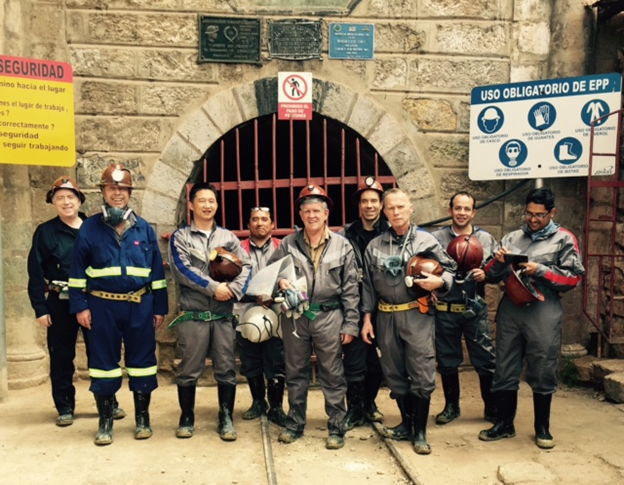
The Morgan Report visit to Pulacayo in 2015 included a
tour of the underground tunnel. The high-grade silver
veins were everywhere and the project is real.
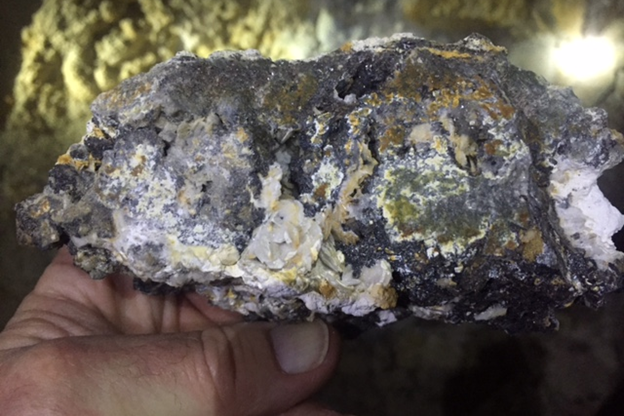
1,000g/t silver samples
Pulacayo: Deja Vu of Lee's Success in 2011 with
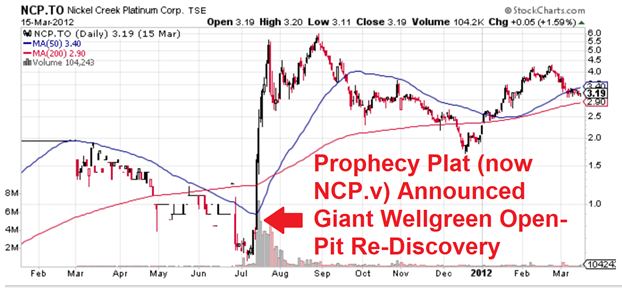
Welllgreen at Prophecy Platinum.
I recall in 2011 when John Lee, who is currently
Prophecy Development's executive chairman but was was
then also the Chairman of Prophecy Platinum,
meticulously assembled Yukon's Wellgreen PGM land
package with a history of disjointed drillings from
various landowners. The consolidated Wellgreen package
ended up with a 150 million+ tonnes open-pit resource
containing millions of ounces of in-situ PGM in the
ground. The resource announcement jolted Prophecy
Platinum stock (now Nickel Creek) tenfold in 2011, many
faithful Morgan Report subscribers profited multi-bagger
from this trade.
Lee's vision and negotiating skills have been masterful
then, and I believe he will do even better with Pulacayo.
Pulacayo is a much better asset than Wellgreen, in terms
of grade, metal recovery, and infrastructure access
(water, power, rail, and port). Second, Lee recruited
Michael Doolin as Prophecy's COO, who built 3 Nevada
gold mines and transformed Klondex Mines Ltd from an
explorer to a billion dollar NYSE-listed company before
it was sold to Hecla in 2018. Third, we are in a full
fledged silver bull market in which silver prices could
run much higher and potentially reach or eclipse the
prior 1980 and 2011 peaks of $50 an oz. In this bull
market, Pulacayo + Prophecy is a can't miss.
Here is the Opportunity
Prophecy just completed a $3.9 million financing lead by
billionaire Eric Sprott who now owns 9% of Prophecy.
With the Pulacayo-Paca resource already approaching 100
million oz Ag (covering just 30% of known
mineralization), resources at Pulacayo would potentially
multiply as Prophecy keeps on drilling to prove up new
resource.
In October 2019, Prophecy received 30-year Pulacayo
mining license, with Bolivian mining minister praising
Prophecy's investment. John Lee said the signing of
Mining Contract was "a landmark milestone in advancing
Pulacayo."
The investment community will soon be caught off guard
and unprepared for what Prophecy is about to unveil-a
generational, world-ranking open-spit silver
re-discovery that rivals San Cristobal.
With San Critobal mine reserve becoming exhausted in
2023, Pulacayo could be a prime take-over candidate by
the Japanese.
In this major silver bull market, Prophecy is trading at
$50 million Canadian, about 1/10 of New Pacific (TSX:
NUAG), whose Silver Sands project is next to Pulacayo.
Simply put, if you own New Pacific, you should also own
Prophecy.
I am a shareholder in Prophecy and am holding on to my
shares. BMO did a $5.5 million bought deal in 2018 at
$0.44 based on Prophecy's vanadium angle. That where
Prophecy is trading at right now ($0.47 with 120 million
shares outstanding).
I urge Morgan Report subscribers to take a serious look
before drill results are in and Prophecy gains further
institutional exposure.
David Morgan
Disclaimer: This subscriber update is not an investment
recommendation. Every investment entails risk, Morgan
Report received no compensation from Prophecy and
recommends you conduct your own due diligence and
consult with your financial adviser before entering into
any type of financial investment.
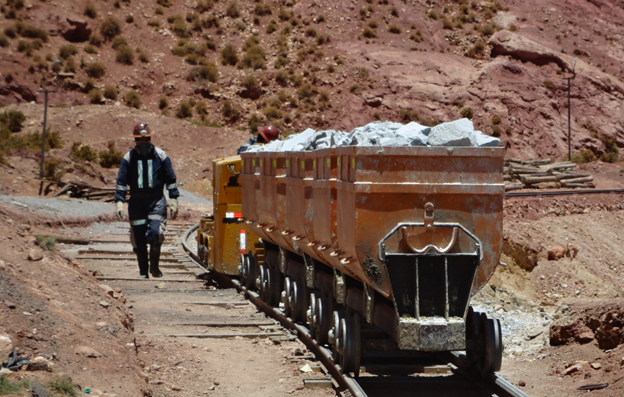
2012 Pulacayo trial mining by Apogee yielded a
high-grade resource (300g/t+) utilizing existing power,
water and nearby toll-milled facility. Zinc and lead
concentrate production was sold to Trafigura.
Historical Background of Pulacayo Mine
Silver mining at Pulacayo began around AD 1545, during
the Spanish colonial period. But there are no recorded
production details. The first work formally recorded was
carried out in 1833. Revenue from the mine funded the
first railway line in Bolivia. In 1888 it connected
Pulacayo to the port of Antofagasta, Chile. In 1891,
reported annual silver production reached 5.7 million
ounces. Mining operations at Pulacayo at that time were
the second largest in Bolivia. Work continued through
the intervening years until the mind was closed in 1959
due to an exhaustion of reserves, a lack of exploration,
and rising costs. The total output from the Pulacayo
mine during this period, as estimated by the National
Geological and Mineral Service of Bolivia (SERGEOTECHMIN),
was 678 million ounces of silver, 200,000 tons of zinc,
and 200,000 tons of lead. Production at Pulacayo was
predominantly derived from Veta Tajo (the Tajo vein
system), which had been defined along a strike length of
3 km and to a depth of more than 1000 m.
|